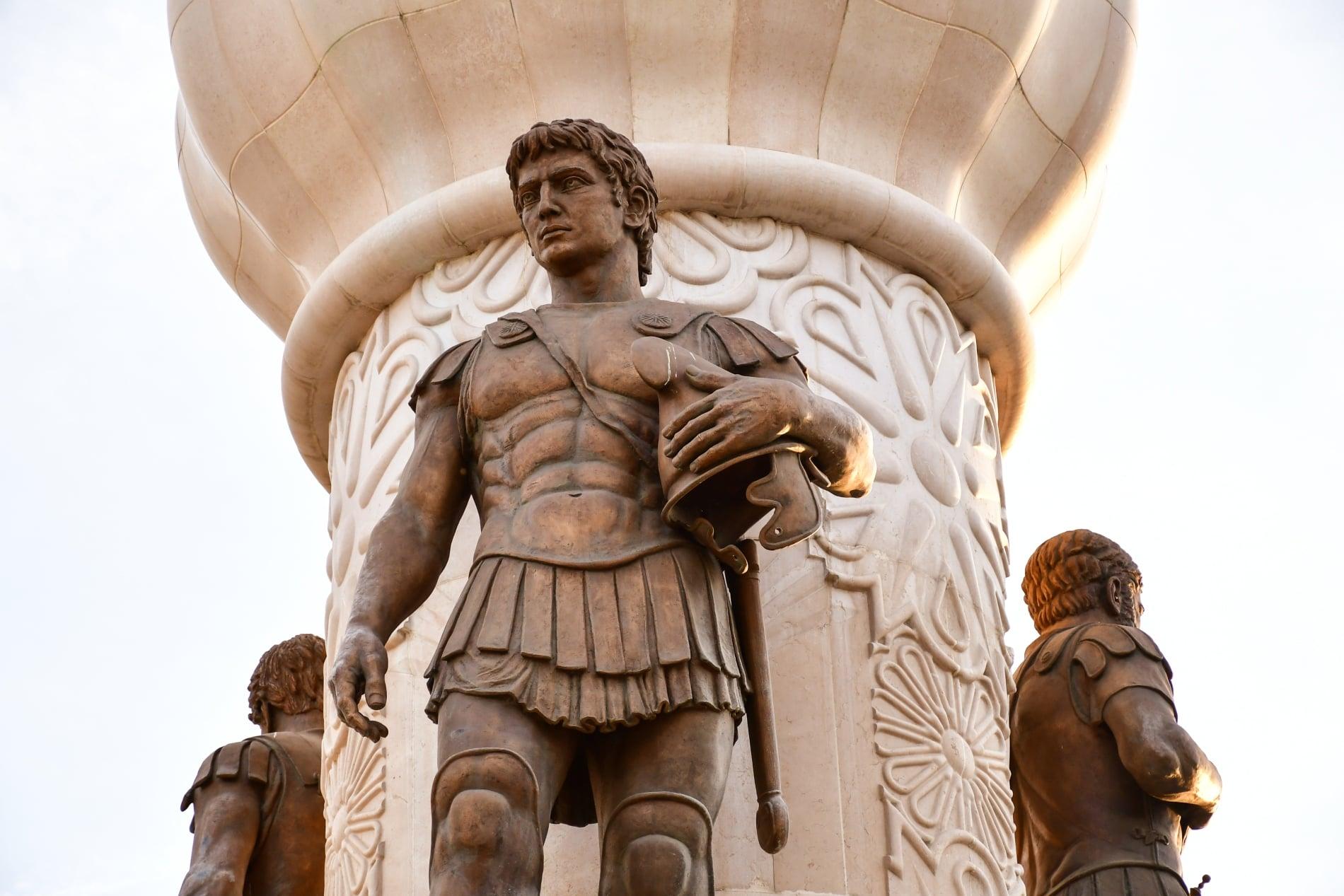
Fact-Checked & Reviewed by Kodawire Editorial Team
Alexander the Great: The Brutal Strategy Behind His Unstoppable Empire
Kodawire Editorial TeamBy Kodawire Editorial Team
Education
May 31, 2026 • 1:50 PM
2m2 min read
Verified
Source: Shutterstock
The Core Insight
This analysis explores the meteoric rise and strategic genius of Alexander the Great, who transformed Macedonia from a regional backwater into the world's largest empire. By examining his innovative use of the phalanx, his psychological warfare, and his complex relationship with his own commanders, we uncover the tactical brilliance that allowed him to dismantle the Persian Empire in just over a decade.
Sponsored
K
Editorial Desk
Kodawire Editorial Team
The Kodawire Editorial Team consists of experienced journalists and subject matter experts dedicated to delivering accurate, well-researched, and engaging content.
The Kodawire Editorial Team consists of experienced journalists and subject matter experts dedicated to delivering accurate, well-researched, and engaging content.
The Architect of Empire: Alexander the Great and the Hellenistic Shift
What You Need to Know
Tactical Innovation: Alexander’s success relied on the 18-foot sarissa pike and the synergy between the phalanx and shock cavalry.
The Cost of Ambition: His empire was held together by personal charisma, not institutional stability, leading to immediate collapse upon his death.
Cultural Fusion: His campaigns triggered the Hellenistic Age, blending Greek philosophy and governance with local traditions across Asia and Egypt.
The Human Toll: The rapid expansion resulted in extreme logistical strain, mutinies, and the eventual destruction of his own inner circle through paranoia.
In 334 BC, a 20-year-old king from the rugged mountains of Macedonia set his sights on the Persian Empire, a superpower that had dominated the ancient world for centuries. Alexander’s campaign was not merely a series of battles; it was a decade-long odyssey that pushed the boundaries of the known world and fundamentally altered the trajectory of human history. While history often paints him as a singular, god-like figure, the reality of his rise and fall is a complex study in military genius, political fragility, and the limits of human ambition.
The legacy of Alexander the Great continues to be a subject of intense historical debate. (Credit: FotoFlo via Unsplash)
How I Researched This
To provide an account of Alexander’s campaigns, I have cross-referenced historical records regarding the Macedonian military structure, the specific tactical maneuvers at Granicus, Issus, and Gaugamela, and the political fallout of his eastern expansion. My research focuses on the logistical realities of the 40,000-strong army and the documented accounts of the mutinies at the Hyphasis. I have stripped away the myth-making to focus on the verifiable military and political decisions that defined his reign.
The Rise of a Macedonian Powerhouse
For centuries, the Greek city-states viewed Macedonia as a backwater. It was Philip II, Alexander’s father, who transformed this peripheral kingdom into a military juggernaut. Philip’s most significant contribution was the professionalization of the infantry. By introducing the 18-foot sarissa pike, he allowed his phalangites to outrange any opponent. When combined with the Hellenic League, Philip created a unified Greek force capable of projecting power far beyond the Aegean.
The Anatomy of Alexander’s War Machine
Alexander’s army was a masterpiece of tactical synergy. At its core were the 9,000 Macedonian phalangites, but they were never intended to fight alone. The 3,000 elite hypaspists acted as the "hinge," protecting the vulnerable flanks of the phalanx. The true shock force, however, was the Companion Cavalry. Led by Alexander himself, these 1,800 elite horsemen were the hammer that struck the decisive blow once the phalanx had fixed the enemy in place.
The phalanx provided the defensive wall necessary for Alexander's cavalry to maneuver. (Credit: Heinz Schneider via Unsplash)
Is the Trade-off Worth It?
When we analyze Alexander’s military investment, we see a high-risk, high-reward strategy. He prioritized speed and shock over defensive sustainability. While this won him battles, it created a "burnout" effect among his troops. The cost of maintaining such a professional, highly-drilled force was immense, and the lack of a long-term administrative structure meant that the empire’s value was tied entirely to his personal presence. Once he moved on, the provinces often reverted to instability.
Three Decisive Battles That Toppled an Empire
Alexander’s military record is defined by his ability to adapt to terrain. At the River Granicus, he ignored conventional wisdom, launching a frontal assault that forced the Persians into a defensive posture they couldn't maintain. At Issus, he exploited the narrow coastal plain to neutralize Darius III’s numerical superiority, effectively turning the geography into a trap for the Persians. Finally, at Gaugamela, he used a feint to draw the Persian center out of position, creating the gap he needed to charge directly at the Great King.
Many assume Alexander’s empire was a "civilizing" mission. In reality, it was a brutal, often paranoid occupation. The destruction of Persepolis and the execution of his own loyal commanders, such as Parmenion and Philotas, reveal a leader who was increasingly isolated by his own success. His attempt to enforce proskynesis, the Persian ritual of prostration, was not just a cultural misunderstanding; it was a desperate attempt to consolidate power in a way that his Macedonian veterans found deeply offensive.
The Practical Checklist
If you are studying the logistics of ancient warfare, focus on these three pillars:
Formation Integrity: Understand how the phalanx maintained a "wall of iron" and why it failed when the formation became disordered.
Logistical Supply Lines: Analyze how Alexander managed food and water for 40,000 men in hostile territory.
Diplomatic Integration: Study how he used local governors (satraps) to maintain order in conquered provinces.
The Limits of Ambition: From India to Babylon
The turning point of Alexander’s career was not a military defeat, but a psychological one. At the Battle of the Hydaspes, the sheer terror of war elephants and the exhaustion of an eight-year campaign finally broke the spirit of his men. The mutiny at the River Hyphasis was the first time Alexander’s will was successfully challenged. His subsequent return through the Gedrosian desert was a logistical disaster that cost thousands of lives, proving that even the greatest military mind could not overcome the harsh realities of geography and supply.
The harsh geography of the Gedrosian desert proved to be a greater enemy than the Persian army. (Credit: حسين احمد رحيم سلمان via Pexels)
The Biggest Roadblock
Most students of history fail to grasp the "succession vacuum." Alexander spent his life building an empire but failed to build a state. He treated his generals as subordinates rather than partners, and when he died in 323 BC at age 32, he left no clear heir. The empire didn't fall because of external enemies; it collapsed because it was never designed to survive its creator. For those looking to understand how to build lasting systems, studying integrity and organizational structure is essential.
The Decision Matrix
If you were a commander in Alexander’s army, how would you handle the following?
Scenario A: You are ordered to perform proskynesis. Do you comply to keep your rank, or refuse and risk execution?
Scenario B: You are at the River Hyphasis. Do you follow the King into India, or join the mutiny to return home?
My Recommended Setup
For those interested in deep-diving into this era, I recommend the following resources:
Osprey Publishing: Their series on ancient warfare provides the most detailed breakdowns of phalanx formations and equipment.
Topographical Maps of the Near East: Essential for understanding why the battles of Issus and Gaugamela were won or lost based on terrain.
What Do You Think?
Was Alexander a visionary who sought to unite the world, or a reckless conqueror whose ambition ultimately destroyed the very empire he built? I will be replying to every comment in the first 24 hours to discuss your take on his legacy.
The primary advantage was the synergy between the 18-foot sarissa pike phalanx, which fixed the enemy in place, and the Companion Cavalry, which acted as the shock force to deliver the decisive blow.
The empire collapsed because it was built on Alexander's personal charisma rather than institutional stability. He failed to establish a clear heir or a long-term administrative structure, leaving a succession vacuum.
The mutiny marked the first time Alexander's will was successfully challenged by his troops, signaling the psychological and physical exhaustion of his army after an eight-year campaign.
Active Engagement
Was this information helpful?
Join Discussions
0 Thoughts
Editorial Team • Question of the Day
"If Alexander had lived another 20 years, do you believe he could have successfully stabilized his empire, or was its collapse inevitable?"